Photos by Sandra Whitehead
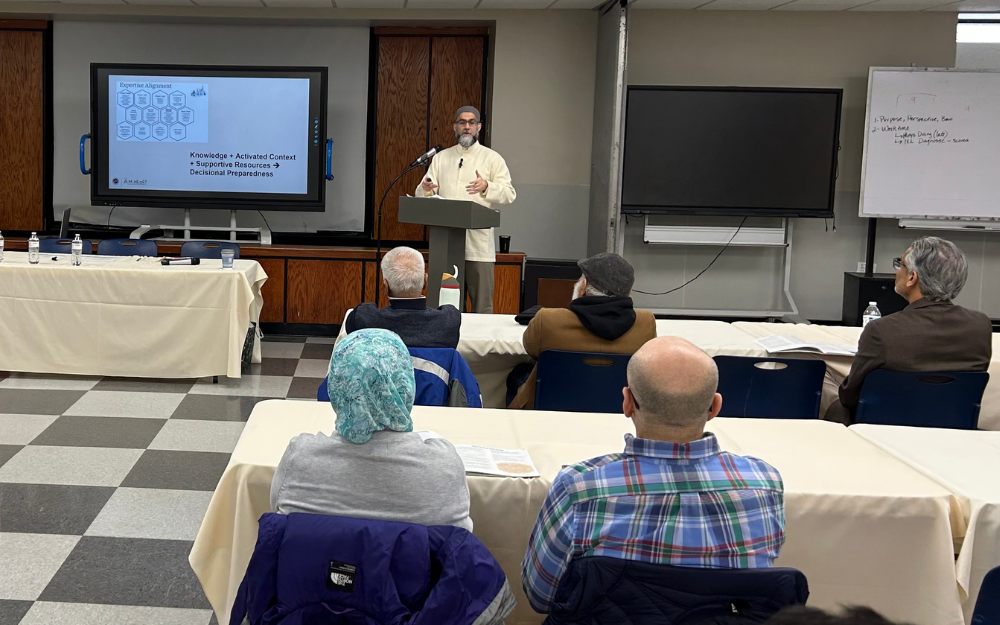
Medical College of Wisconsin Professor Aasim I. Padela, M.D., founder and president of the Initiative on Islam and Medicine, discussed Islamic bioethics during a January workshop on end-of-life decisions at the Islamic Society of Milwaukee.
The Islamic Bioethics & End-of-Life Healthcare Decisions workshop had just begun when one of the speakers received a WhatsApp message. Aasim I. Padela, M.D., Professor of Emergency Medicine and Medical Humanities at the Medical College of Wisconsin, and the founder and president of the Initiative on Islam and Medicine, stepped up to the podium.
“While I was sitting here, I got this on my phone. ‘My brother has been dealing with AML (acute myeloid leukemia), which is an aggressive cancer type, for the last two years,’” he read. “’He’s a medical student and most of us in the family are physicians. We were discussing end-of-life decisions. As a medical family, we are very well-versed in the medical aspects. Basically, AML has a five-year survival rate of 33%. We are having a hard time with trying to understand the Islamic side. He is intubated in the ICU. What should we do?’
“I often get texts like this,” Dr. Padela said. “Obviously, they want an Islamic response. Should they keep him on intubation or should they withdraw life support?”
Dr. Padela asked the audience, “Imagine this is your child in the I.C.U., a young person with aspirations to be a doctor, facing an aggressive cancer. What do you do? What does Islam have to say?” He promised to return to this question after providing frameworks for the many aspects one must consider when making decisions about the end of life.
About 50 people attended the four-hour workshop, Islamic Bioethics & End-of-Life Healthcare Decisions, held Jan. 31 at the Islamic Society of Milwaukee. It featured experts with backgrounds in medicine, palliative care, hospice and Islam. Speakers made presentations and led discussions about practical steps, resources and strategies to help Muslims “transition from a state of uncertainty about end-of-life healthcare to thoughtful preparation for it,” a workbook given to participants stated.
The workbook, Islamic Bioethical Considerations for End-of-Life Healthcare: A Guide for Muslim Americans Navigating End-of-Life Decisions with Islamic Values and U.S. Healthcare Tools, aims to support Muslim Americans as they navigate end-of-life healthcare in a way that honors both Islamic ethics and U.S. laws, it states. Its publication was sponsored by the Initiative on Islam and Medicine, the Muslim Community & Health Center and the Medical College of Wisconsin. For more information about the workshop and workbook, email [email protected].
At the workshop, Dr. Padela, an Islamic bioethics expert and clinical researcher, addressed Islamic bioethics in end-of-life decisions. Renee Foutz, M.D., a hospice educator and clinician, explained what hospice is and isn’t, clarifying misconceptions and answering questions from the audience.
A case study review concluded the workshop. A panel of three medical professionals, Padela, Foutz and Ismail Quryshi, M.D., from Froedtert and MCW (who practices hospice and palliative care and internal medicine) used the case study “to bring all the workshop topics from theory to practice,” team member and community academic researcher Laila Azam, Ph.D., M.B.A., told the Wisconsin Muslim Journal.
This article focuses on Dr. Padela’s discussion of Islamic bioethics in end-of-life decisions.
link