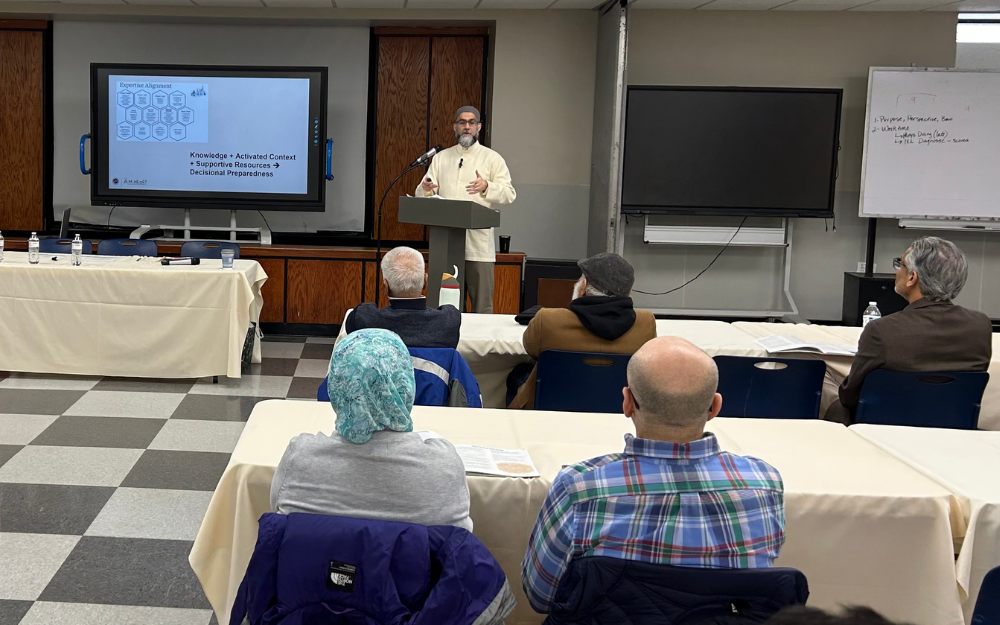
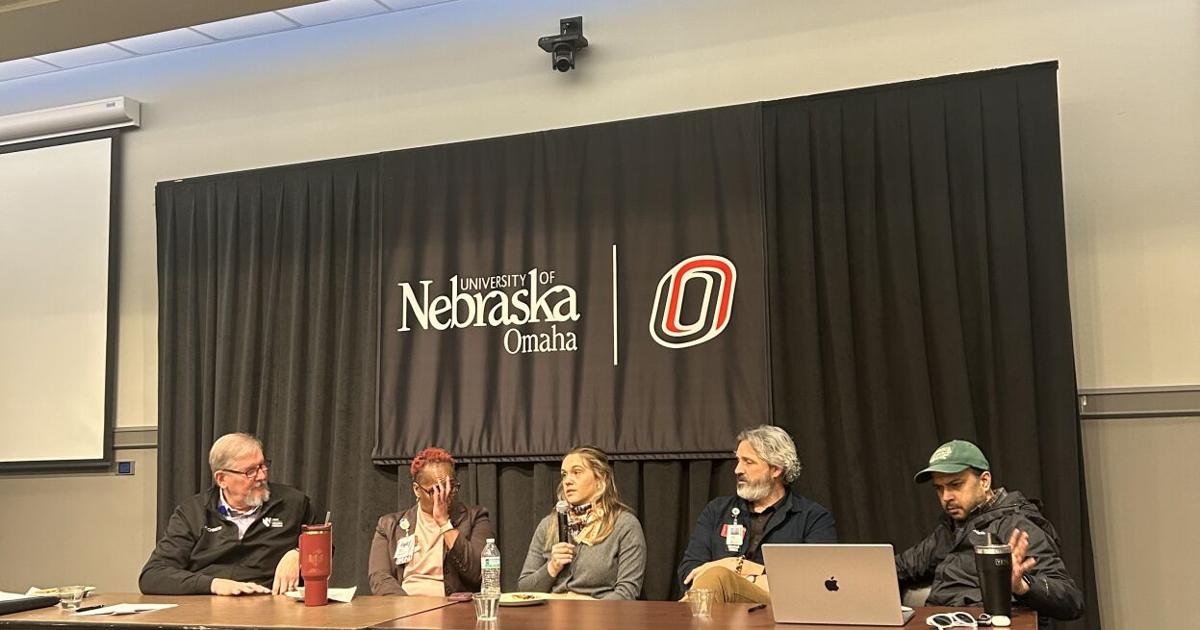
UNO staff and Nebraska Medicine faculty joined together on Thursday, Feb. 5th, in the Milo Bail Student Center to host a panel about medical ethics.
This panel is part of a series on medical ethics, where speakers go to both Nebraska Medicine and UNO.
Titled “Ethics Grand Rounds: The Clinician-Patient Relationship”, the panel focused on how to navigate the difficulties and ethical dilemmas associated with clinician-patient relationships.
Four guests from Nebraska Medicine were invited to speak, and the event was moderated by Bharat Ranganathan, PhD, a UNO professor.
The guests spoke about their experiences with the clinician-patient relationship, then opened the floor to questions from students, many who are in courses with Ranganathan.
Ranganathan wants to help push the conversation about medical ethics to a wide range of individuals.
“Our goal is to engage clinicians, community members, students and others,” he said.

Guests sit at the front of the panel answering questions.
One of the speakers was Jacob Dahlke, who is the Director of Health Care Ethics at Nebraska Medicine. He works to facilitate ethic consultations.
Dahlke’s job focuses on what happens when the clinician-patient relationship breaks down.
He spent some time speaking about the unusualness of these relationships.
“It’s unlike anything else in society,” he said. “You are meeting people when they’re weak,”
Dahlke advised students who are interested in a career in healthcare to really pay attention to the intricacies and the dynamics of the clinician-patient relationship.
Emma Luling is a Risk Manager at Nebraska Medicine, and also spoke at the panel. She started her career in clinical social work.
Luling expanded on how caregivers need to provide support to help patients where they’re at, and help them thrive in their community. She talked about using personal history and experiences to build a relationship.
Luling did note how sometimes patients may not be as receptive to a provider’s advice.
”We have to realize there is a fine constraint of what we can do or support,” she said.
Shanda Ross is the Director of Community Impact for People Development and Culture at Nebraska Medicine. At the panel, she shared her insights from her career to students.
Starting her career as a nurse, Ross wants students to know that to help other people, you have to be comfortable with yourself, and make your own decisions.
“You are the very first person on your board of directors,” she said.
Ross believes it is especially important to focus on what the patient is experiencing in their life, and be cognizant of social drivers of health.
“Learn what you can contribute,” she said.
Steven Wengel is a Geriatric Psychologist at Nebraska Medicine and the Assistant Vice Chancellor for Campus Wellness at UNMC.
Wengel spoke to students at the panel on actionable steps he is taking to strengthen the clinician-patient relationships in his own life.
He told students about patients not showing up to appointments, and how it is important to not blame them, but rather to try and understand where the patient may be coming from.
“Maybe it’s a transportation problem, or maybe it’s something else,” Wengel said.
After each of the guests spoke, students asked many questions about topics such as private equity, the Nebraska Medicine merger, and how to navigate certain situations as a provider.
The speakers echoed each others’ answers throughout the panel, but one message rang true: their mission to provide care to patients, no matter what.
Luling repeated the sentiment.“Healthcare will always exist,” she said.
link