
It’s been just over a year since Queen’s announced it would welcome a Canada Excellence Research Chair (CERC) in Immunophysiology and Immunotherapy to campus. Paul Kubes is a world-leading expert on the immune system, and understanding how it can be harnessed to treat chronic disease. His work leverages existing institutional strengths in immunology, cancer research, and precision medicine, positioning Canada as a global hub for translational research on immune-based therapies.
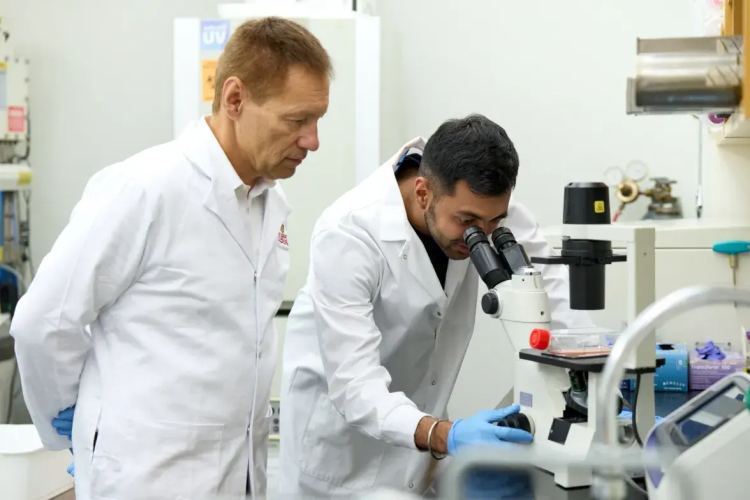
Dr. Kubes and PhD student Kartik Sachdeva examine a cell sample under a microscope.
Under the CERC program, a federal government initiative that attracts up to $8 million in funding over eight years, Dr. Kubes has been busy developing his research program, from advancing research across several areas of immunology and fostering a collaborative team to building a state-of-the-art laboratory. We explore some of these highlights below.
New insights into neonatal immunology
Earlier this year Dr. Kubes published new research in the high-impact journal Science Immunology, exploring why newborns are so susceptible to infections like sepsis and meningitis. The research seeks to understand the vulnerability of babies during the first few weeks of life.
“In the first four weeks of a baby’s life, their immune system is the most vulnerable to infections, and premature births elevate the risks even further,” says Dr. Kubes. “Bloodstream infections are a significant concern, and understanding the mechanisms behind this vulnerability is essential for developing ways to protect them.”
To investigate, Dr. Kubes and his colleagues used advanced intravital microscopy to observe the immune response in one-day-old mice exposed to infections. Their findings revealed that Kupffer cells, the specialized immune cells in the liver responsible for filtering blood, are initially located outside the liver’s sinusoids (blood vessels). This positioning limits their ability to capture and neutralize pathogens effectively.
During the first week of life, these cells undergo a process known as reverse migration, moving into the sinusoids where they become better equipped to trap and eliminate pathogens. This transition is crucial for establishing a functional immune system.
The delayed migration of Kupffer cells to the sinusoids in animal models may explain the heightened susceptibility to bloodstream infections. Dr. Kubes and his team believe that a similar phenomenon may occur in human newborns emphasizing the potential for these insights to improve clinical outcomes in neonatal care.
link