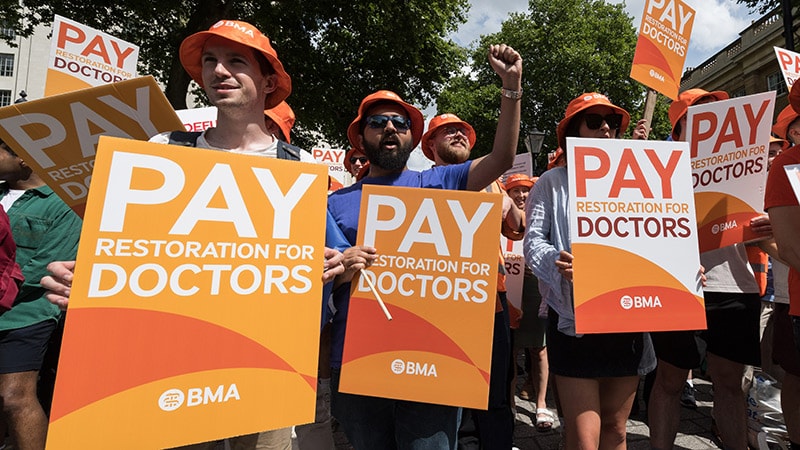

When working conditions for healthcare professionals become untenable, individuals may seek remedy through official employment tribunals — a solo pursuit for justice. But history tells that individual voices often lack leverage. When workers band together, their voices carry more weight. That’s the premise behind trade unions: Collective bargaining was born from the realisation that workers were stronger when they acted in unison rather than as scattered voices.
However, strikes by doctors are ethically distinct from those in sectors such as transport or postal services. The reason is self-evident — the suspension of medical services has immediate and potentially severe implications for patient wellbeing. But this ethical tension does not necessarily mean that collective action is unethical; rather, it demands a more nuanced moral framework.
Disruption is not incidental to strike action; it is the mechanism by which pressure is applied. Without disruption, power imbalances remain unchallenged. When NHS doctors strike, they are seeking to influence the policies and priorities of the government. In this sense, strike action becomes a form of political coercion. Protest that causes no inconvenience is unlikely to be effective. Thus, when critics point to the “harm” caused by doctor strikes, they are, in effect, acknowledging that the protest is working as intended.
Defining ‘Harm’
The media debate surrounding healthcare strikes tends to flatten the concept of harm into a binary: Either harm occurs, or it does not. But harm, particularly in medical ethics, is better understood as a spectrum. A missed outpatient appointment is not equivalent to a missed cancer diagnosis — both may be harmful, but they differ dramatically in magnitude and moral weight.
Ethically, harm is often treated as a threshold concept: something to be avoided when possible and minimised when it cannot be. But the assertion that doctor strikes must be entirely harm-free to be justified is philosophically incoherent and practically impossible.
A reductio ad absurdum may help expose this. If doctors were always bound to prioritise patient care above all else — even under unjust, unsafe, or exploitative conditions — it would logically follow that a single doctor would be ethically compelled to work alone on a ward of 200 patients, without rest, indefinitely. Clearly, such a claim is ethically unsustainable.
Instead, we must ask: What level of harm is proportionate, and is the harm being incurred in pursuit of a morally significant aim?
Acute vs Chronic Harm
A 2023 study published in the Journal of Economic Behavior & Organization examined the 2016 junior doctor strikes in England. In their analysis of the final 48-hour walkout, which impacted both emergency and elective services, researchers found no significant increase in mortality or emergency readmission rates in affected hospitals. From an acute care perspective, this is a crucial point; strike-related disruptions did not appear to result in immediate loss of life.
However, the story does not end there. Emergency care may have functioned as normal, but strikes inevitably affect the broader healthcare system. Senior clinicians redeployed to emergency roles during strikes are often pulled from outpatient clinics and elective lists. This creates delays — in diagnosis, in treatment, in surgical intervention. For instance, such delays could mean the difference between early-stage cancer and metastatic disease. These are genuine, albeit less visible, harms and the medical profession risks losing credibility if it attempts to persuade the public that strike action results in zero harm overall.
But is it ethical to weigh these chronic harms against longer-term systemic harm caused by deteriorating workforce conditions? Many striking doctors argue yes. They use a utilitarian approach, suggesting that the harm of today’s delayed appointment must be weighed against the harm of tomorrow’s doctor shortages, rota gaps, and a failing NHS — outcomes that systematically undermine patient care on a far larger scale.
The Paradox of the Essential Worker
An uncomfortable irony arises: If doctors claim their work is essential — which it is — how can their absence be harmless?
To argue that strikes cause no harm risks eroding the very argument for why doctors matter. But to admit that harm occurs does not render strikes unethical. Rather, it reframes the debate: The ethical standard should not be the absence of harm, but its justification.
Utilitarianism, Justice, and Just Cause
Some clinicians draw on utilitarian reasoning to justify industrial action. Short-term harm now is outweighed by long-term benefits to the system, such as improved recruitment, safer staffing ratios, and ultimately, better patient outcomes. Critics, however, may see this as an ethical smokescreen — an attempt to use the prosperity of the wider NHS as the motive, when in fact the main motive behind strikes is the desire for personal gain through better pay.
However, this criticism doesn’t hold ethically if individual pay is intrinsically linked to public health. A 2014 paper by Mpho Selemogo argued that wage-related strikes are justifiable “only if the wages of the doctors can be shown to be so poor as to compromise public health.” While pay is certainly part of the equation, it is not the only — nor always the most decisive — factor driving retention of doctors. A 2022 report from The King’s Fund highlighted that workplace culture, rota design, and leadership support were more significant predictors of why doctors choose to stay or leave.
Selemogo also proposes two further conditions for ethical strike action. The first is proportionality: Industrial action must not aim to inflict disproportionate harm, especially on vulnerable patient groups. If the British Medical Association chose to target the most understaffed, underfunded hospitals in the UK, they would risk falling off the ethical tightrope. The second condition is a reasonable hope of success. If strike action is plainly futile, it loses its ethical justification. However, with the recent decline in NHS waiting lists being positioned as one of Sir Keir Starmer’s key early achievements, some ministers have expressed concern that doctors may now hold a potent form of leverage over Whitehall.
Rethinking Harm and Ethics in Strike Action
Doctor strikes present complex ethical dilemmas, and how one frames the concept of harm is central to this discussion.
There must be openness about the extent to which harm can ensure, whilst acknowledging that ethical strike action requires consideration of the proportionality of harm and the potential for long-term benefits.
Arya Anthony Kamyab is a foundation year 1 doctor working in the Northeast of England. You can follow him on Instagram @aryak.writes.
link